Friday, January 23, 2015

Day 7 Pylos, Southwest Coast of the Peloponnese

Looking south along the west coast.


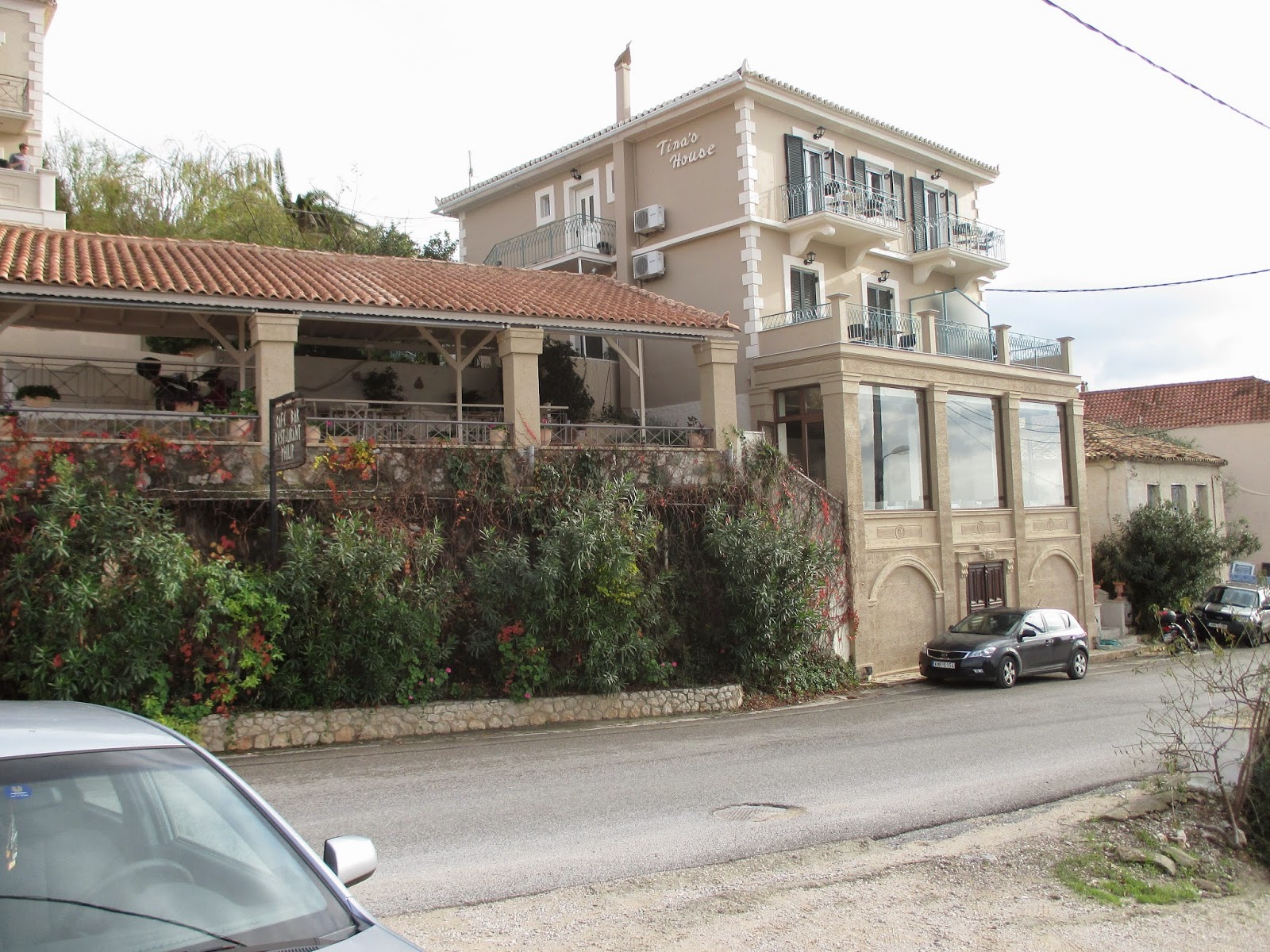
Our hotel in Pylos.

Walled city at Methoni doth of Pylos.

Windy day at Methoni.

Main gate to the city.

Moat along the walls.

Bridge over the moat.

More moat.

More to the city wall.

Bridge and moat

Greek lesson.

Another castle at Koroni.

The village of Koroni.

Koroni.

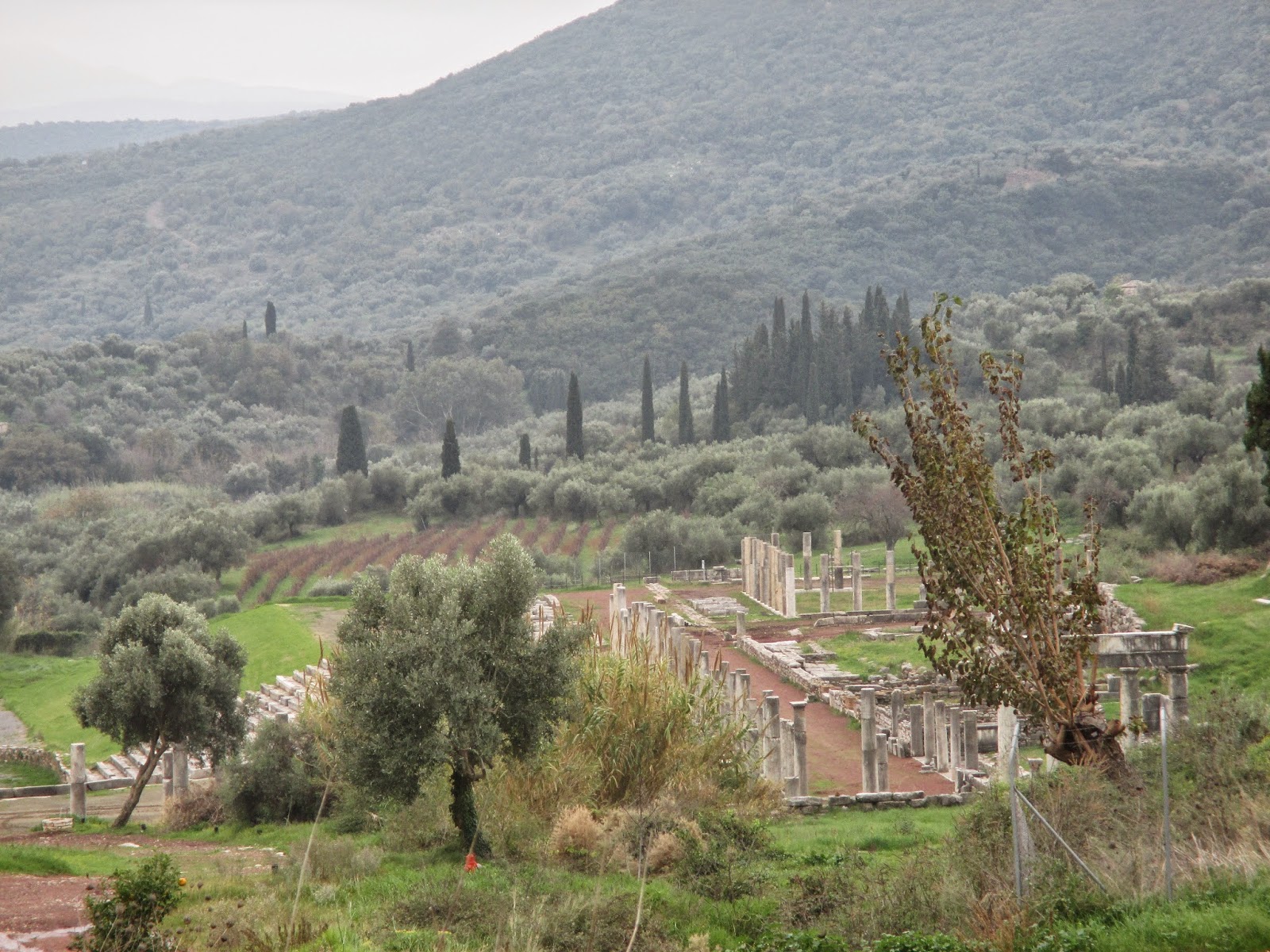
Ruins at Messini.

This is a table with standard measures.  It is at the market place still in its original position.

Tow other standards measuring tables with different volume measures.

Close-up of oe of the measuring bowls.  You can see the hole in the bottom that you would unplug and have the grain fall through into your container.

Messini.  Entrance to a large temple.

Theater at Messini.

Messini

Messini, looking down at the stadium and a family tomb.

Gymnasium at Messini.

Stadium seating.

Thumbs up.

Colonnade  along the top of the stadium.

More of the colonnade.

Finally a latrine!  Complete with water running under it.

Entrance to the gymnasium.

Messini defensive walls.

Guard tower in the wall.

Another view of the city walls and guard tower.

City wall.

Archway at a monastery.

Pylos and its harbor.  This is where King Nestor sent his ships from to assist the Mycenaeans with the Trojan War.

West from Pylos over the mountains on the way to Sparta.

Fall colors on the way to Sparta.

Scenery on the way to Sparta.

More fall colors.

Spooky tunnel.

Terrifying tunnel.

You can tell we like this scenery.

Add caption

Scenery with fog.  We had the road to ourselves.

Monday, January 19, 2015

Day 6 Temple of Apollo and Mountain Towns

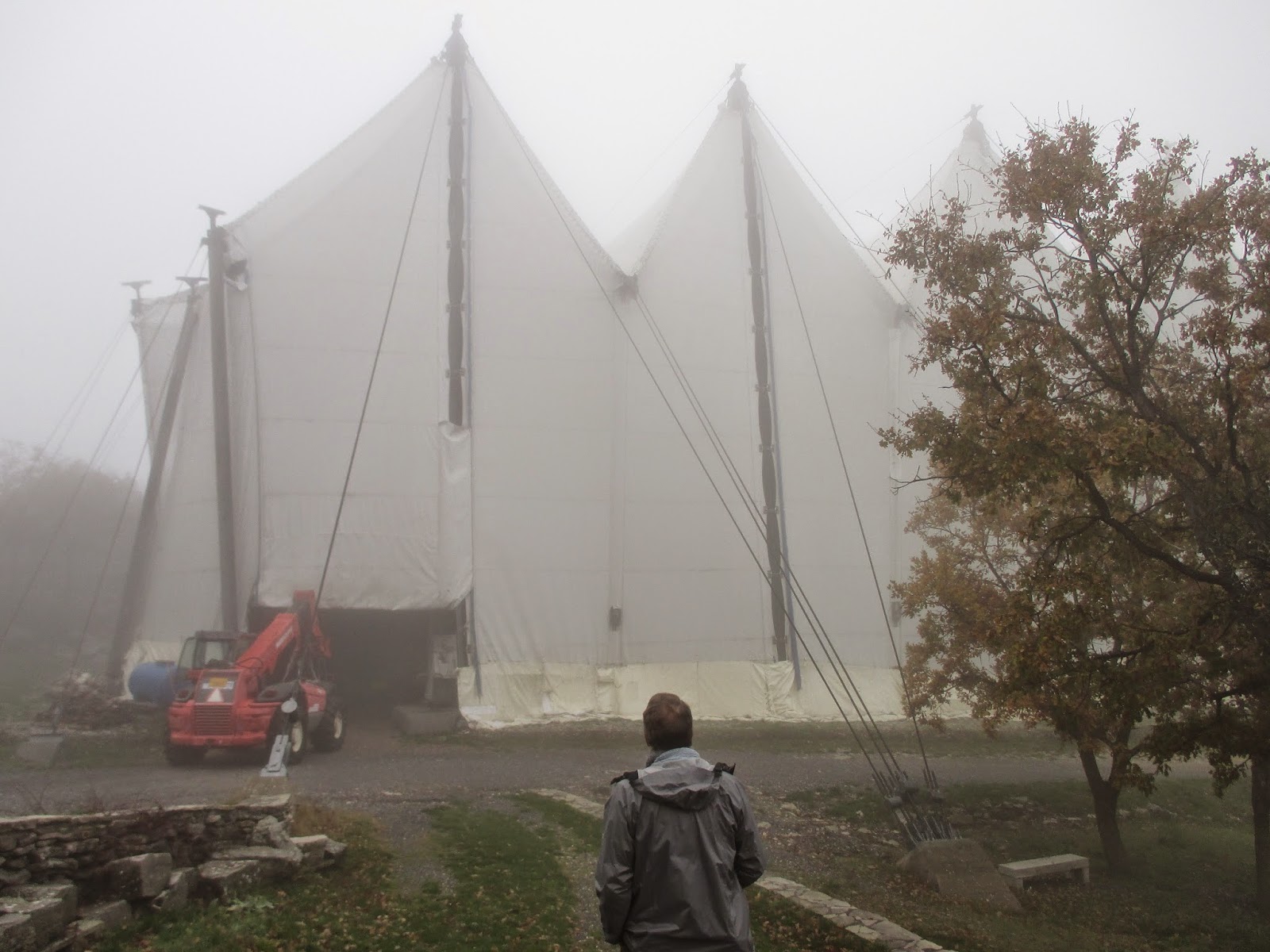
The day we visited the Temple of Apollo was very foggy.  The white tent like structure covers the temple to protect it from the weather.

Another view of the tent from another direction.

The temple is being restored.  The equipment and opening are for the people working on the temple.

The front of the temple.  The collars on the columns and the truss work inside are stabilizing the columns until their foundations are restored.

Looking down the left side.  This temple is high up in the mountains south west of Olympia.  although some of the temple had fallen down in earthquakes, all of the pieces are still there.  The temple was so far away that it was not worth the time for people to use it as a quarry for building later buildings.

Looking down the right side.  The foundation is in better shape on this side.

This is the back side.  You can see the fully restored foundation.  Once the foundation is resorted there is no need for the collars at the top.  The column off to the side has been lifted by a crane off it's foundation so the foundation can be fixed.  It will then be put back in place.  This project has been on going for over 20 years.  It looks as if it will require a couple more generations of restorers to compete it.  I only hope the tent can last that long.

Beautiful mountain town with all stone buildings.

Closer view of the village.  None of the roofs here are flat.  There is too much snow in the winter.

Power plant way in the distance.

Another mountain village in the same area near the Temple of Apollo.

More of the village.

Village with surrounding mountains.

Lunch by the fire.  It was cold and foggy again.

Day 5 Olympia

Ruins at Olympia.

The Stadium at Olympia.  There were no seats for the spectators.   The stone line across is the starting line of races.
A round Ionic Temple built by Philip of Macedonia.  A more recent addition from 300 BC.
The Doric temple of Hera in the background.  The grassy area in the foreground is where the Olympic torch starts.

Thursday, January 1, 2015

Day 4 Nimea and on to Olympia

This tunnel at Nimea leads to the games stadium.  This is where the athletes would enter.  It was a very important discovery.  Until this was found, it was thought that the Greeks didn't know how to build arches.  Evidently they did know!  And it seems to have lasted awhile.

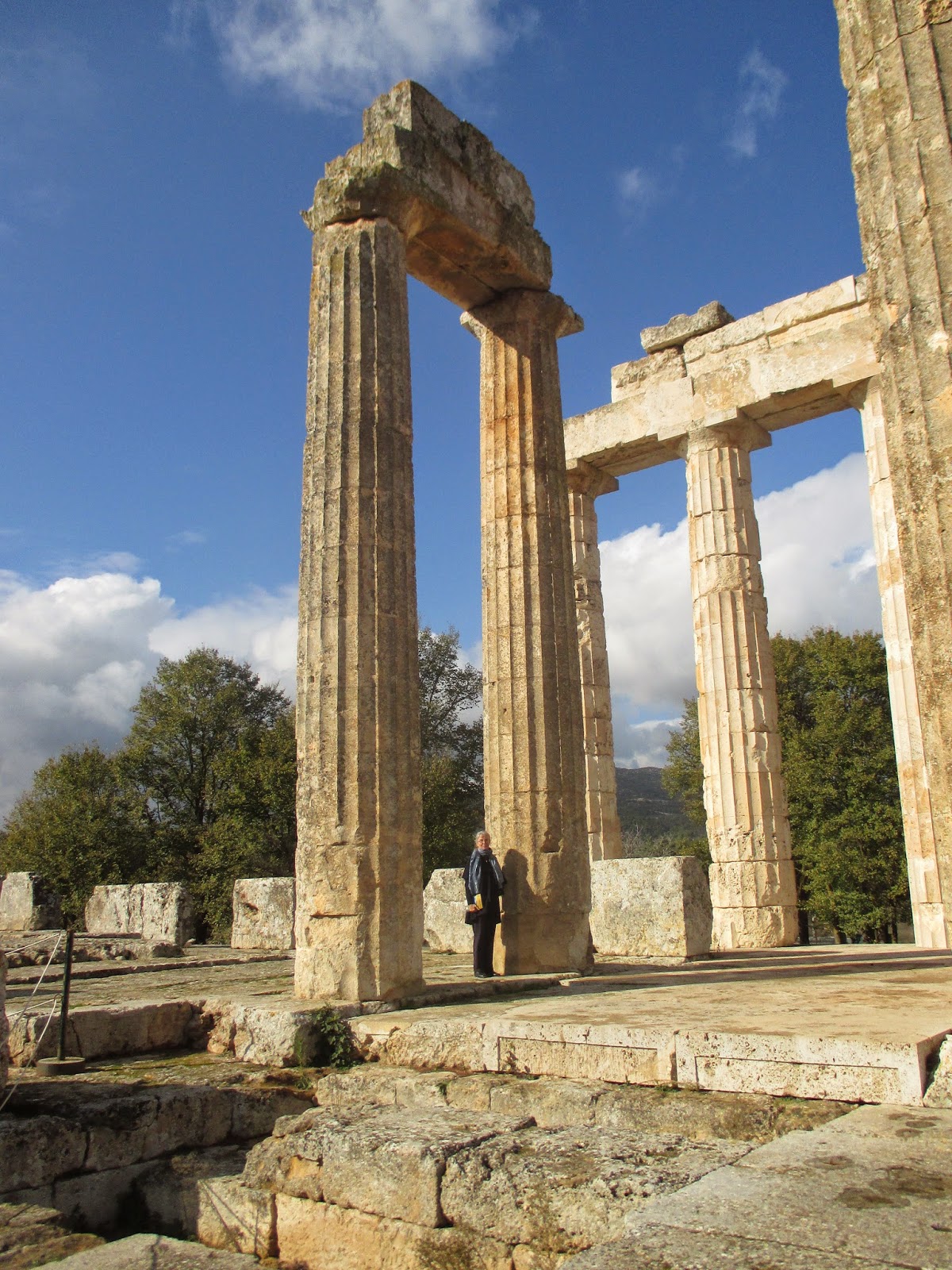
This is one of the temples at the sanctuary at Nimea.  Hercules was here.  One of his labors took place with the Nimean lion.   I was very fun to be allowed to walk into the temple and touch the columns.

Over the mountains to the west of Nimea.  We were lost at the time.  We thought we were going to drive through the village in the valley.  We missed the turn off somewhere along the way.

Up into the fog.  This beast startled us.  It is a very large goat, but it looks to us like a very large bull on our first glimpse.

More goats in the fog.

Over the mountains and a view of the decent towards the west coast and Olympia.  the town is called Kandila.  We visited family of Peter, my coworker.  This is his father's village.  The picture doesn't do it justice.  It was positively sparking in the sunlight.

Day 3 Napvlio All Day


We spent this day on a walking tour of Napvlio and visited the art museum.


This is taken from the main platia looking toward an old mosque that is now a community center.  The hillside behind is one of the many castles that cap the mountains to the southeast of the city.

This is the school.  You can't hear the noise in the picture.  The children were on recess when we took the picture.  Lots of energy!

A pretty carved fountain from the Turkish times.

Looking up at the largest castle.

The castle in the harbour.

Looking at a castle wall and the town that climbs up to the base of the walls.

An archway at the entrance of the steps up to one of the castles.  About 1,000 steps to the top.  WE drove up the road on the other side!  Not enough time to walk it.  At least that was the excuse at the time.

at the entrance of one castle looking up the the highest castle in the distance.

Looking down on the city from one of the castles.

Classic castle stone work with a pretty cypress tree.

A nice view of Napvlio from the highest castle.  Mycenae is located way in the back ground up near the mountains.

Two castles from the highest castle.  We walked on the pathway around the point of land.

Pretty view through an arch.

another pretty view.  You can see the castle in the harbor.  From here it looks tiny.

Dramatic castle wall view.

2014 Seasons Greetings

Merry Christmas and Seasons greetings.  We hope you have a wonderful 2015! 

For us this past year has been full of events, many delightful, some tragic, and some bitter sweet.  I suppose this is much like any typical year for most of us.  But in any case, I feel thankful today for all blessings.  

On Christmas eve we did some time traveling.  We felt like we went back 1000 years or so, before the split between the Western Latin Church and the Eastern Orthodox Church.  Imagine a mountain hillside, a pitch black night with clear skies and bright stars; no electricity or plumbing.  All beeswax candle light, two small windows, beautiful freshly pained Icons with gold painted backgrounds glowing on the iconostasis (the wall separating the body of the church from the alter).  The church was about 25 feet by 40 feet with a barrel vaulted roof, inside were about 70 people.  Women sat on the left side facing the Iconostasis and men on the right. Monks chanting, priest chanting, no other sound from inside or outside the church apart from the rustling sound of the congregation rising and siting at mysterious intervals (mysterious to us).  There are no pews, only chairs, benches, and stools, and not quite enough of them for the entire congregation.  Some people stood outside the open door to the church.  Incense, church bells, real church bells.  We arrived after the service was in progress (about 10:30 PM), we stayed until about 1:30 AM.  The liturgy part of the service, that Roman Catholics would recognize parts of didn't start until about 12:30 AM, prior to that there were many prayers and traditions to fulfill.  We left before it was finished, but after the Host was consecrated.  So I don't know how long the entire service lasted.  These Christian traditions have been in practice for over 1,500 years without substantial change.  It was a very beautiful experience to witness.  And  it was enchanting to participate in something so old, yet still thriving, first hand.  It was an amazing transition from our current world to visit a much older world.  We are looking forward to the Easter liturgy.  From what we understand, that one is even more elaborate although we can't think how it could be more beautiful that this Christmas liturgy.   

Blessings and love to all for the coming year.

Here is a picture of the church in the daylight.  The church is new, but the Liturgy is old.   Maybe as old or older than the olive tree in the foreground.