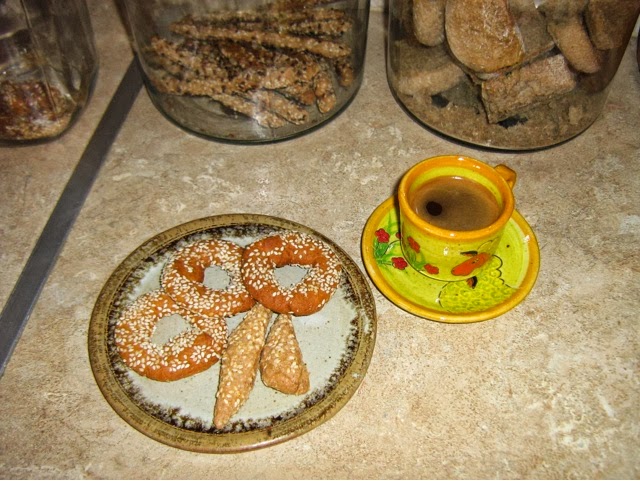
Argrioupolis is south and east of Chania, up in the mountains a bit. It is built on top of the Roman city Lappa. The town is divided in two parts, the upper and lower. The upper is perched high on a hill side with lovely views; the lower part is in a small canyon filled with springs and waterfalls. We stayed in the upper part and hiked down the donkey trail to the lower part, where we ate dinner and then we hiked back up in the dark. We had a bit of an adventure finding a hotel. We ended up stopping at a house along the Main Street that had the door open and the old folks watching what was passing by on the street, which was us. After I went into the house for some cookies with the Grandma, the Grandpa took Grier to find a person that rented some rooms. And so we found a hotel. We had planned to stay two nights but the weather didn't cooperate with the type of clothes we brought. It was surprisingly cold and windy. So we only stayed one night. But I would like to go back someday, especially to find the gentleman that gave us an amazing tour of the town so we can thank him properly. We got to go inside some old buildings, look down into one of the opening to the old Roman cisterns, see his antique camera and last but not least we went to the hidden shed with the hidden Raki still and shared a drink with him. We went for a walk the second day down to the Necropolis of Lappa where we saw the 2,000 year old Plane tree and some poetry. Then we were too cold to stay so we drove over the mountains to the south shore and had dinner overlooking the beach where people were swimming and sun bathing. Se we warmed up and yet again had a wonderful meal. I am going to have to start taking pictures of the meals more often, they are so beautiful! Forgot to mention that we got to hear some traditional music and dancing at the lower village.
Sunday, November 3, 2013
Between Then and Now, Aptera
I must write a blog, I must write a blog, I must write a blog...This is what I have been thinking and have not been doing! We have had quite a few small adventures since Grier wrote about our cross island trip. I sat down about an hour ago and started looking at our pictures and got a bit overwhelmed. I decided to write 5 small blogs, one for each adventure, and they will be short otherwise I will never make it though.
This one is about Aptera. It was on a large flat hill overlooking Souda Bay. The first two pictures are of the hill where Aptera was located. They are taken from Marathi which was one of the ports for Aptera and also one of the guard posts for Souda Bay when Aptera was thriving. Aptera was a Roman City. It must have been magnificent. The other pictures are take at the ruins and our lunch in the present day town of Aptera. This place (Crete) reminds me over and over just how short lived our human civilizations are. Not necessarily a pleasant thought to be reminded of on a daily basis!
Thursday, October 24, 2013
Making Greek Coffee
Disclaimer: This is a way (not the only way) to make Greek coffee.
First, you will need the beans of your choice finely ground in a machine like the one in the first photo. All the makings are shown in the second photo, from left to right: sugar, the coffee, a briki, and a small cup. The briki is for cooking the coffee and can be aluminum with a heavy bottom, good for electric stoves, or brass, best for a gas flame.
Measure water into the briki using your cup. Mix in sugar, amount depending on taste, and the coffee. The amount of coffee also depends on taste, but Greek coffee is generally strong, so a heaping teaspoon, as shown in the photo, is the right amount per small cup. Stir until blended.
Put the briki on the element or flame at a low temperature. This coffee is best cooked slowly and best when it is not brought to a hard boil at the end. The next photo shows the coffee cooking, and the following one, the coffee just at the boiling point, when it should be removed from the heat. Stir the coffee a few times to develop the foam, and return to the heat, bringing it back to the boiling point. Remove again and stir again. The coffee should smell chocolaty and have a nice foamy "head".
Pour the coffee into your cup, see what snacks you can find, and enjoy.
First, you will need the beans of your choice finely ground in a machine like the one in the first photo. All the makings are shown in the second photo, from left to right: sugar, the coffee, a briki, and a small cup. The briki is for cooking the coffee and can be aluminum with a heavy bottom, good for electric stoves, or brass, best for a gas flame.
Measure water into the briki using your cup. Mix in sugar, amount depending on taste, and the coffee. The amount of coffee also depends on taste, but Greek coffee is generally strong, so a heaping teaspoon, as shown in the photo, is the right amount per small cup. Stir until blended.
Put the briki on the element or flame at a low temperature. This coffee is best cooked slowly and best when it is not brought to a hard boil at the end. The next photo shows the coffee cooking, and the following one, the coffee just at the boiling point, when it should be removed from the heat. Stir the coffee a few times to develop the foam, and return to the heat, bringing it back to the boiling point. Remove again and stir again. The coffee should smell chocolaty and have a nice foamy "head".
Pour the coffee into your cup, see what snacks you can find, and enjoy.
Wednesday, October 23, 2013
Catching up
We are behind with our blog posts, but we don't want to jump ahead just to catch up. So, the next two or few posts cover trips we took in September and early October, and we hope, even if they are a little late, you'll find them interesting.
After dropping Jeff off at the Iraklion airport, we continued east, but not far, camping near Sisi, just past the Minoan Palace of Malia. In the morning of the following day we visited the palace. In the afternoon, we visited the Lasithi Plateau, inland from Malia, famous for its windmills and the Dhiktean Cave, near Psihro, where Zeus was born. In fact, there are two caves on the island that boast being Zeus' birthplace: the Dhiktean Cave and the Idean Cave, not far away. Zeus knows which one, we will have to speculate.
These adventures left us with a late evening's drive to Ayios Nikolaos (Saint Nickolaus) on the east side of the Gulf of Mirabello. After driving down some uncomfortably narrow streets we finally found the hotel. Who were we to know that the entrance was by elevator from the back of a mini-mart?
The next day, from St Nick, we continued east, with Vai, the famous palm beach of Crete, as our destination, but stopping in Gournia, yet another Minoan town, on the way. Vai was crowded, but relaxing nonetheless, and we swam and toasted in the sun under the palms, before heading just a little further north to Itanos. Here are the ruins of an ancient Greek city, a small but lovely beach, and some flats away from the beach perfect for camping.
Sitia was our first stop the next day, where we spent who knows how much time in the museum looking at the excellent collection of pottery. From here, we headed out to our most eastern destination - could it be?, yes, once again, a Minoan palace, this time at Kato Zakros. We ended the day driving over the mountains to the south coast and camped near Koutsouras.
Heading home the following day, no Minoan palaces today, our main stop was the Arkadhi monastery, famous as a symbol of Cretan resistance; a sort of Cretan Alamo.
Here are a few pictures:
After dropping Jeff off at the Iraklion airport, we continued east, but not far, camping near Sisi, just past the Minoan Palace of Malia. In the morning of the following day we visited the palace. In the afternoon, we visited the Lasithi Plateau, inland from Malia, famous for its windmills and the Dhiktean Cave, near Psihro, where Zeus was born. In fact, there are two caves on the island that boast being Zeus' birthplace: the Dhiktean Cave and the Idean Cave, not far away. Zeus knows which one, we will have to speculate.
These adventures left us with a late evening's drive to Ayios Nikolaos (Saint Nickolaus) on the east side of the Gulf of Mirabello. After driving down some uncomfortably narrow streets we finally found the hotel. Who were we to know that the entrance was by elevator from the back of a mini-mart?
The next day, from St Nick, we continued east, with Vai, the famous palm beach of Crete, as our destination, but stopping in Gournia, yet another Minoan town, on the way. Vai was crowded, but relaxing nonetheless, and we swam and toasted in the sun under the palms, before heading just a little further north to Itanos. Here are the ruins of an ancient Greek city, a small but lovely beach, and some flats away from the beach perfect for camping.
Sitia was our first stop the next day, where we spent who knows how much time in the museum looking at the excellent collection of pottery. From here, we headed out to our most eastern destination - could it be?, yes, once again, a Minoan palace, this time at Kato Zakros. We ended the day driving over the mountains to the south coast and camped near Koutsouras.
Heading home the following day, no Minoan palaces today, our main stop was the Arkadhi monastery, famous as a symbol of Cretan resistance; a sort of Cretan Alamo.
Here are a few pictures:
Subscribe to:
Posts (Atom)